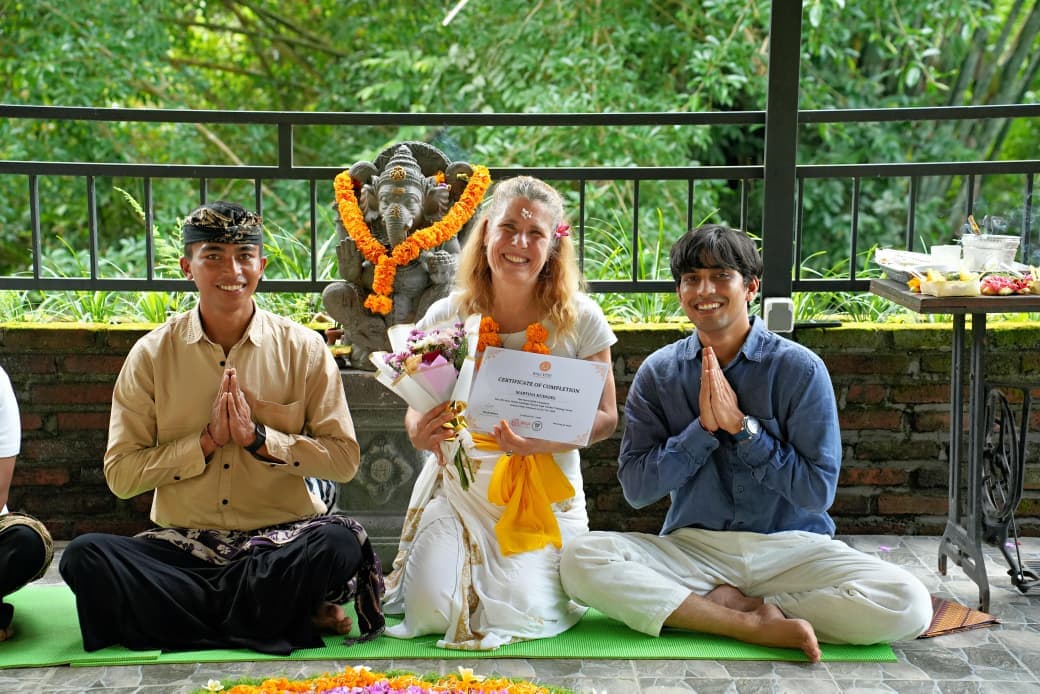

It is 6:30 AM in Ubud. The Pekerisan River murmurs below the shala. A group of students at Bali YTTC have just finished their morning Ashtanga practice. Now they lie in Savasana. I begin to guide them through Yoga Nidra.
Within minutes, the room transforms. Breathing slows. Faces soften. Bodies sink. They are not asleep — but they are not quite awake either. They are in a space that most adults never visit consciously: the threshold between waking and dreaming, where the nervous system heals, the mind unwinds, and something ancient and wise takes over.
Twenty minutes later, students open their eyes looking as if they have slept for hours.
“What just happened?” they always ask.
The answer is Yoga Nidra — and in this complete guide, I’ll explain everything: what it is, where it comes from, the science behind why it works, the 8 stages of a full practice, its extraordinary benefits, and how you can start today.
If you are a yoga teacher or planning to train as one, this is also one of the most valuable skills you can learn — and one of the most sought-after by students in 2026.
What is Yoga Nidra? The Simple Explanation
The name comes from two Sanskrit words: yoga meaning “union” and nidra meaning “sleep.” But Yoga Nidra is not sleep — and that distinction is everything.
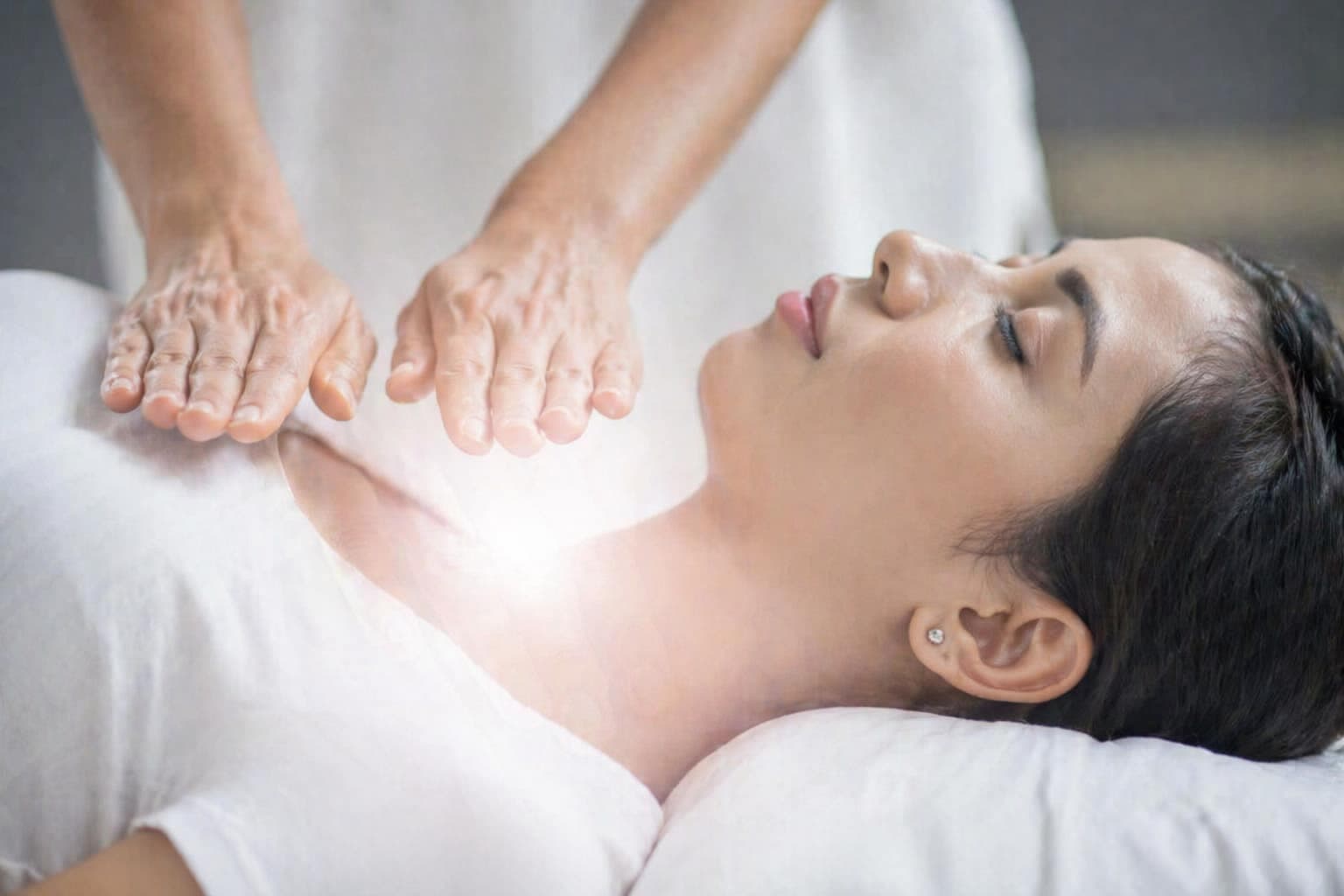
Yoga Nidra is a guided meditation practice performed lying down that leads you into a state of consciousness between waking and sleeping. Your body enters deep rest — comparable to the deepest stages of sleep — while your mind remains gently, consciously aware.
Think of it this way: in ordinary sleep, you are unconscious and unaware. In Yoga Nidra, your body sleeps but your awareness stays present. You descend into the deepest layers of your mind while remaining able to hear and follow a guide’s voice.
This is what makes it so uniquely powerful. You access the subconscious and unconscious mind with full, wakeful awareness. Healing, transformation, and deep rest all happen at once.
30
minutes = 2–3 hours of deep sleep restoration
22%
reduction in cortisol per session in research studies
800K+
people search Yoga Nidra every month globally in 2026
4
brain wave states accessed — beta, alpha, theta & delta
The Ancient Roots of Yoga Nidra
Yoga Nidra is not a modern invention. Its roots run deep through thousands of years of yogic and tantric tradition.
The earliest mentions appear in the ancient Hindu epic the Mahabharata, which describes “yoganidra” as the transcendental sleep of Lord Vishnu between cosmic cycles. The Upanishads describe states of consciousness that correspond closely to what we now call Yoga Nidra. Various medieval Hatha Yoga texts use it as a synonym for the deep meditative state of samadhi.
The modern form was systematised by the great Indian yogi Swami Satyananda Saraswati in 1976, who developed the 8-stage method still taught today. He described it as “a systematic method of inducing complete physical, mental, and emotional relaxation.”
Since then, Yoga Nidra has been adopted by the US Army for PTSD treatment, studied in neuroscience and psychology, and is now used in hospitals, corporate wellness programs, and yoga schools worldwide — including here at Bali YTTC in Ubud.
Yoga Nidra vs Meditation vs Sleep — What is the Difference?
Practice | Body State | Mind State | Position | Brain Waves |
|---|---|---|---|---|
Yoga Nidra | Deeply relaxed, still | Aware but receptive | Lying (Savasana) | Alpha → Theta → Delta |
Meditation | Relaxed, upright | Active — focused or observing | Seated | Alpha, some Theta |
Ordinary sleep | Deeply relaxed | Unconscious, unaware | Any position | Theta, Delta |
Savasana | Relaxed, still | Relaxed, often drifting | Lying down | Alpha |
The key difference between Yoga Nidra and meditation is direction. Meditation asks you to do something — focus on the breath, observe thoughts, return to a mantra. Yoga Nidra is more receptive. You follow a guide’s voice and simply allow. There is no effort, no technique to master, no way to do it wrong.
This is why Yoga Nidra is often the ideal entry point for people who say they “can’t meditate.” You just lie down and listen.
The Science of Yoga Nidra — Why It Works
Modern neuroscience has begun to confirm what yogis have known for thousands of years. Here is what research shows:
Brain Wave Shifts
During normal waking life, the brain operates in beta waves — fast, analytical, often anxious. As you enter Yoga Nidra, brain waves slow to alpha (relaxed awareness), then theta (the hypnagogic state between wake and sleep where deep healing and creativity live), and in longer practices even delta (deep sleep restoration). This is why 30 minutes can feel like hours of sleep.
Nervous System Reset
Yoga Nidra activates the parasympathetic nervous system — the “rest and digest” mode — within minutes. This directly counteracts chronic stress, which keeps most modern people locked in “fight or flight.” The result: cortisol drops, heart rate lowers, blood pressure decreases, and the body begins to restore itself.
Access to the Subconscious
In the theta state, the mind becomes unusually receptive to intention and deep healing. This is where the sankalpa (personal intention) is planted. Like a seed dropped into fertile soil, intentions set in this state penetrate far deeper than conscious affirmations. This is also why Yoga Nidra has been used clinically for PTSD, trauma recovery, anxiety disorders, and chronic pain management.
The 8 Stages of Yoga Nidra — A Complete Breakdown
The system developed by Swami Satyananda Saraswati follows 8 distinct stages that systematically guide you from outer awareness to the deepest layers of the self — and back again.
Stage 1
Internalisation (Pratyahara)
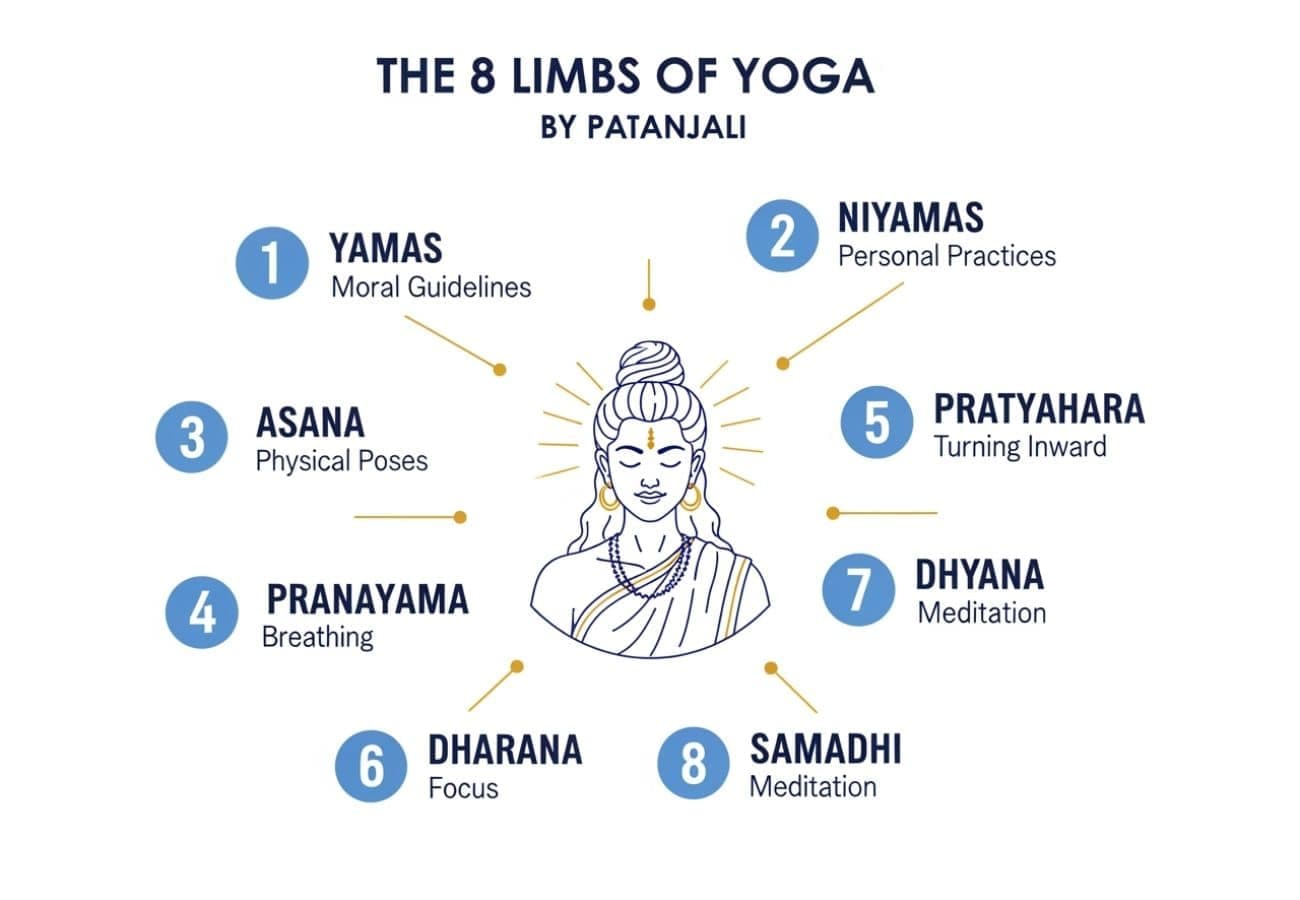
Physical settling. Gentle instructions help withdraw attention from the outside world. This is pratyahara — the 5th limb of Patanjali’s 8 Limbs of Yoga.
Stage 2
Sankalpa (Intention)
A brief personal intention is planted at the threshold of deep consciousness. Examples: “I am calm and at peace.” “I am becoming a confident teacher.” The mind is at its most receptive — the sankalpa goes deep.
Stage 3
Rotation of Consciousness
Awareness is guided rapidly through different body parts in a set sequence. Moving so quickly the analytical mind cannot keep up, the brain shifts into theta waves. This is the signature technique of Yoga Nidra.
Stage 4
Breath Awareness
Simple observation of the natural breath — not controlling it, just watching. Breathing slows and deepens. This deepens the theta state and prepares the mind for the more advanced stages ahead.
Stage 5
Pairs of Opposites
You are invited to experience pairs of opposite feelings — heaviness and lightness, heat and cold, joy and sadness. By experiencing the full spectrum in a safe relaxed state, the nervous system learns not to react strongly to either extreme.
Stage 6
Creative Visualisation
A series of rapid images are presented — a golden sunrise, a vast ocean, a lotus flower. In deep theta, the mind processes these at a subconscious level, releasing stored tension, emotions, and patterns.
Stage 7
Sankalpa (Second Planting)
The personal intention is repeated once more — now at the deepest point of the practice. This double planting of the seed is one of the most powerful aspects of Yoga Nidra for personal transformation and habit change.
Stage 8
Externalisation (Return)
Gently, awareness is guided back — to the body, breath, sounds of the room. Movement returns slowly. The practitioner returns to ordinary waking consciousness carrying the deep rest and stillness of the practice into daily life.
12 Science-Backed Benefits of Yoga Nidra
🧠 Reduces stress and anxiety
Activates the parasympathetic nervous system within minutes, dropping cortisol by up to 22% per session.
😴 Dramatically improves sleep
30 minutes equals 2–3 hours of deep sleep restoration. Highly effective for insomnia and sleep disturbance.
💛 Heals trauma and PTSD
Used by the US Army and clinical therapists for trauma recovery. The theta state allows safe processing of stored emotional pain.
❤️ Lowers blood pressure
Consistent practice is shown to reduce hypertension — a natural tool for cardiovascular health.
🌀 Reduces chronic pain
Endorsed by the US Attorney General in 2010 as a treatment for chronic pain. Works by releasing tension held in the body at a subconscious level.
✨ Boosts creativity
The theta state is where the brain’s most creative, insight-generating activity happens. Many artists and writers use Yoga Nidra as a creative tool.
🎯 Accelerates personal transformation
The sankalpa planted in theta reaches the subconscious directly — far more powerful than conscious affirmations or willpower alone.
🔋 Restores energy deeply
A single 20–30 minute session provides profound physical restoration — ideal for busy professionals and anyone experiencing burnout.
⚖️ Builds emotional balance
The opposites stage trains the nervous system to remain equanimous — reducing emotional reactivity and building resilience.
🫁 Improves respiratory health
Deep diaphragmatic breathing during practice strengthens lung capacity and supports the respiratory system.
🧘 Deepens meditation practice
Regular Yoga Nidra makes seated meditation easier and more profound by training the mind to access theta states with increasing ease.
🌍 Accessible to absolutely everyone
No physical ability required. No flexibility. No experience. Just the willingness to lie down and listen. The most democratic yoga practice there is.
How to Practice Yoga Nidra: Step-by-Step Guide for Beginners
What You Need
A yoga mat, bed, or any flat surface
A blanket — the body cools quickly in deep relaxation
A bolster or pillow under the knees for lower back support
An eye pillow or folded cloth over the eyes (optional but helpful)
A guided Yoga Nidra recording or a qualified teacher
20–45 minutes of uninterrupted time
💡 The golden rule of Yoga Nidra
Unlike most forms of meditation, falling asleep is not a failure — it simply means your body needed rest. With practice, you will increasingly be able to remain at that threshold of consciousness without slipping into full sleep. Be patient with yourself.
Your 7-Step Practice Guide
Step 1 — Set up your space
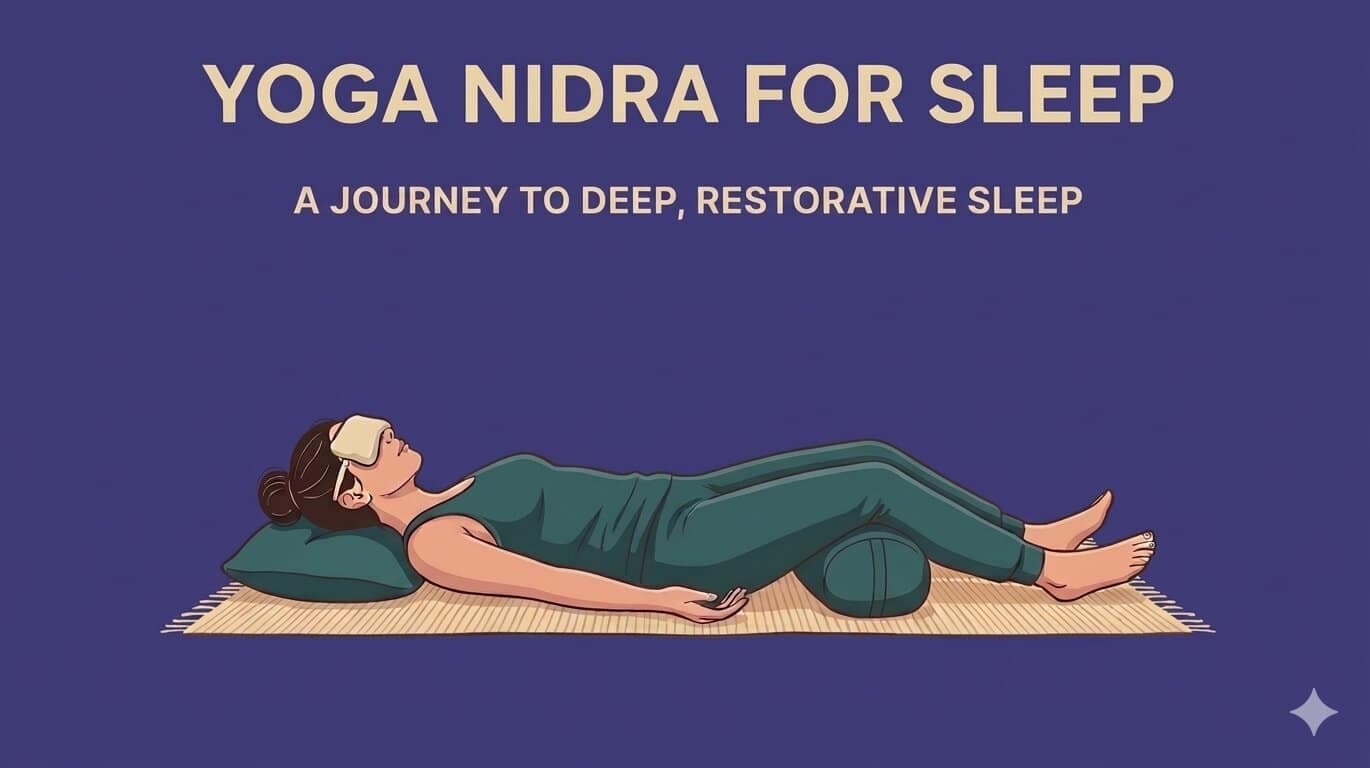
Lie on your back in Savasana. Place a bolster under your knees. Cover yourself with a light blanket. Switch off your phone. Allow 5–10 minutes after eating before beginning.
Step 2 — Set your sankalpa
Before the guide begins, quietly state your personal intention three times in your mind. Keep it short, positive, and present tense. “I am healing.” “I am at peace.” “I am becoming the teacher I was meant to be.”
Step 3 — Begin the guided practice
Start your recording or follow your teacher’s voice. The only instruction: stay aware. Do not try to control anything. Do not try to relax — just follow the voice. Let the practice carry you.
Step 4 — Follow the body rotation
As the guide names each body part, bring your awareness there instantly and move on. The speed is intentional — do not pause, just touch each part with awareness and follow. This is the technique that induces theta brain waves.
Step 5 — Welcome every experience
During the opposites and visualisation stages, simply allow whatever arises — images, feelings, memories. Nothing needs to be analysed. The subconscious is doing its own work. You are the witness.
Step 6 — Return slowly
When the guide brings you back, honour the transition. Wiggle fingers and toes. Take a deep breath. Roll gently to your side before sitting up. Spend 2–3 minutes in silence — this transition is part of the practice.
Step 7 — Practice consistently
Research suggests 3–5 sessions per week of 20–40 minutes each for optimal results. Even once a week creates noticeable changes over time. The benefits are cumulative.
How Long Should a Yoga Nidra Session Be?
Session Length | Best For | Stages Covered |
|---|---|---|
15–20 minutes | Morning practice, quick restoration, complete beginners | Stages 1–4 |
30 minutes | Daily practice, stress relief, sleep preparation | All 8 stages (condensed) |
45–60 minutes | Deep healing, trauma processing, intensive retreat practice | All 8 stages (full depth) |
At Bali YTTC, our students practice a 30–45 minute Yoga Nidra as part of the regular training schedule — often after the morning Ashtanga or Vinyasa practice, when the body is warm and the mind is open. The combination is deeply transformative.
Yoga Nidra and the 5 Koshas — The Deeper Philosophy
To understand why Yoga Nidra is so profoundly effective, it helps to understand the Kosha model from yoga philosophy — the five layers of human experience:
Annamaya Kosha — the physical body (addressed in body rotation)
Pranamaya Kosha — the energy/breath body (addressed in breath awareness)
Manomaya Kosha — the mental/emotional body (addressed in opposites and visualisation)
Vijnanamaya Kosha — the wisdom/intuitive body (accessed in deep theta)
Anandamaya Kosha — the bliss body (touched in the deepest stages)
Yoga Nidra is one of the only practices that systematically moves through all five layers in a single session — healing on physical, energetic, emotional, mental, and spiritual levels simultaneously.
This deep philosophy is a core topic in our 200-hour YTT in Bali, alongside pranayama, meditation, the 8 Limbs of Yoga, anatomy, and full teaching methodology.
Yoga Nidra for Yoga Teachers — Why You Need This Skill in 2026
If you are a yoga teacher or planning to become one, Yoga Nidra is arguably the most valuable skill you can add to your teaching toolkit right now. Here is why:
The global wellness market is shifting toward nervous system regulation and deep rest — and Yoga Nidra is at the centre of this shift in 2026
Corporate wellness programs across Europe and North America are actively seeking teachers who can offer Yoga Nidra for employee stress management
It is ideal for digital products — audio recordings you can sell on Insight Timer, your own website, or Spotify
It requires no physical demonstration — accessible to teachers at any age or physical ability
Students who experience Yoga Nidra in your class always come back
“The first time I guided a Yoga Nidra at the end of a class in London, three students came up with tears in their eyes. One said it was the first time she had felt truly relaxed in two years. That moment changed how I understood what yoga is really for.”
— Emma, Bali YTTC graduate, now teaching in London
At Bali YTTC, our experienced teachers include Yoga Nidra as a core component of the training — not just something to experience, but something to learn to guide. By graduation, every student has both practised and taught Yoga Nidra multiple times.
Experience Yoga Nidra in Ubud, Bali — at Bali YTTC
There is something about practising Yoga Nidra in Ubud that amplifies everything. The sounds of the Pekerisan River below the shala. The call of tropical birds. The warm air carrying the scent of morning offerings. The spiritual energy of a place where Balinese Hinduism has been practised uninterrupted for centuries.
This is the environment where our students experience Yoga Nidra during the 200-hour YTT in Bali — and they describe it as among the most profound experiences of their lives.
“I cried during Yoga Nidra on day four of the training. Not from sadness — from relief. Something I had been carrying for years just let go. I didn’t expect that. I didn’t expect any of this.”
— Aline, Switzerland, Bali YTTC graduate
Beyond Yoga Nidra, our training includes Tibetan sound healing, temple purification ceremonies, meditation, pranayama, and the full depth of yoga philosophy taught in the living context of Balinese culture. See what our graduates say in our testimonials.
Frequently Asked Questions About Yoga Nidra
Can anyone practice Yoga Nidra?
Yes. Yoga Nidra requires no physical ability, no flexibility, no prior experience, and no ability to “clear your mind.” It is one of the most accessible practices in all of yoga. The only requirement is the willingness to lie down and listen.
Is it okay if I fall asleep during Yoga Nidra?
Yes — especially as a beginner. Falling asleep simply means your body needed rest. With regular practice, you will gradually develop the ability to remain in that threshold state. Do not force wakefulness. Allow what is.
How is Yoga Nidra different from a body scan meditation?
Body scan meditation stays at the physical level. Yoga Nidra goes much deeper — through all five koshas. It also includes the sankalpa, opposites, and visualisation stages that body scan does not have. It is a far more complete system.
How often should I practice?
Research suggests 3–5 times per week of 20–40 minutes for optimal benefit. Even once a week produces noticeable results. Consistency matters far more than duration.
Can I practice Yoga Nidra before bed?
Yes, though you may fall fully asleep before the practice completes — which is perfectly valid as a sleep tool. For the full consciousness-expanding benefits, practice in the afternoon or after your morning yoga session.
Is Yoga Nidra taught in yoga teacher training?
It is taught at Bali YTTC as a core curriculum component. Students both experience and learn to guide full Yoga Nidra sessions as part of their Yoga Alliance certified training. It is one of the most requested skills by graduates when they start teaching.
What is the best Yoga Nidra for beginners?
Start with a 20–30 minute guided session from a qualified teacher with no goal other than rest. If you want to learn Yoga Nidra in its full depth — including how to teach it — consider joining our 200-hour Yoga Teacher Training in Bali.
Experience Yoga Nidra in the Heart of Ubud, Bali
Join Bali YTTC for an immersive yoga teacher training where Yoga Nidra, pranayama, meditation, and the full depth of yoga philosophy are taught by experienced teachers in a stunning jungle setting. Yoga Alliance certified since 2018. 2,500+ graduates.
Visit Our Ubud Sanctuary

Written by Vivek Kalura
Senior Faculty & Cultural Scholar. Guiding students to connect mechanical adjustments with spiritual lineage under the tropical Ubud foliage.
Become a Certified Teacher
Study anatomy, philosophy, and alignment in our immersive Ubud programs.