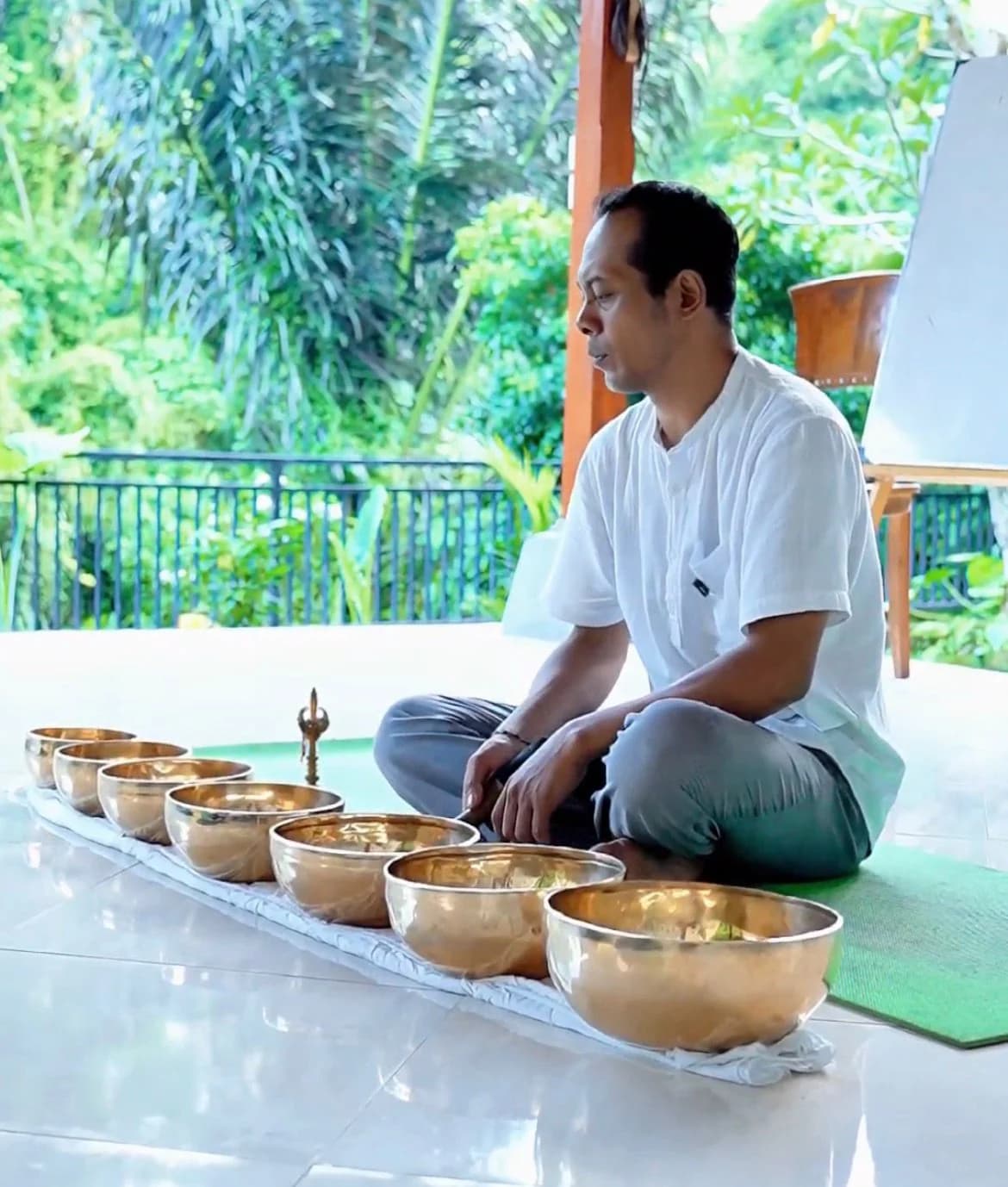

Inside the deep, emerald jungles of Ubud, Bali, a unique form of therapy has captured the hearts of spiritual seekers and scientific minds alike: the Sound Bath. Lying down on a comfortable organic mat, surrounded by the moist, warm air of an open-air shala, you close your eyes as the resonant vibration of crystal singing bowls and hand-hammered Tibetan metal bowls washes over your body. It is a deeply restorative experience, but why exactly does sound healing work so powerfully—especially within a tropical jungle environment?
1. The Physics of Sound in High-Humidity Shalas
Sound is a physical force. It travels as a wave of pressure through a medium—and that medium is air. In the high-humidity environment of Ubud’s jungle shalas, the air is dense with water vapor. Physics tells us that sound waves travel faster and maintain their physical resonance longer in warm, humid air than in dry, air-conditioned rooms. This means the acoustic frequencies generated by singing bowls physically penetrate your skin, muscles, and fascia with greater depth and intensity, creating a tangible physical micro-massage on a cellular level.
If you want to experience this natural acoustic physics for yourself, our open-air bamboo shala is the perfect sanctuary. Learn more about our location on our Ubud Campus page.
2. Brainwave Entrainment: Moving from Beta to Theta States
At any given moment, the neurons in your brain are communicating via electrical impulses, producing brainwaves. When you arrive in Bali, your brain is likely operating in a high-frequency Beta state (12–30 Hz), associated with active thinking, stress, and analytical processing. Sound healing works through a process called entrainment—the tendency for two oscillating systems to lock into a matching phase. The steady, pure tones of crystal bowls gently slow your brainwave cycles down:
- Alpha state (8–12 Hz): Reaches a calm, relaxed, yet alert state of mind.
- Theta state (4–8 Hz): The state of deep meditation, creative dreaming, and cellular healing. Here, the critical mind falls asleep, allowing deep emotional release.
- Delta state (0.5–4 Hz): A state of dreamless, restorative sleep where the body repairs tissues and releases stress hormones.
3. Crystal Bowls vs. Tibetan Metal Bowls
Our sound healing sessions utilize a combination of two powerful acoustic tools:
| Bowl Type | Material | Acoustic Property | Therapeutic Effect |
|---|---|---|---|
| Crystal Bowls | 99.9% Pure Quartz Crystal | High-frequency, pure, singular sine-wave tones. | Targets specific energetic centers (chakras), bringing mental clarity and focus. |
| Tibetan Bowls | Alloy of 7 Sacred Metals | Complex, multi-tonal, grounding, warm harmonic overtones. | Grounds the physical body, releases muscular tension, and targets the physical bone structure. |
4. Releasing Muscular and Nervous System Tension
An intensive yoga training involves 8 to 10 hours of daily physical activity, breathwork, and lectures. Your body will feel exhausted if it is not given time to down-regulate. Sound baths stimulate the vagus nerve, which triggers the parasympathetic nervous system (the "rest and digest" mode). This lowers your heart rate, reduces blood pressure, and relaxes the muscles of the lower back, neck, and shoulders. We schedule sound baths as part of our excursion and workshop schedule, providing the ultimate recovery after challenging training days. Read our guide on the Sound Healing activity details to see how we pair it with ice baths on excursion days.
Ready to immerse yourself in sound, yoga, and nature? Check out our upcoming program dates to secure your space in our next training cohort.
Visit Our Ubud Sanctuary

Written by Vivek Kalura
Senior Faculty & Cultural Scholar. Guiding students to connect mechanical adjustments with spiritual lineage under the tropical Ubud foliage.
Become a Certified Teacher
Study anatomy, philosophy, and alignment in our immersive Ubud programs.