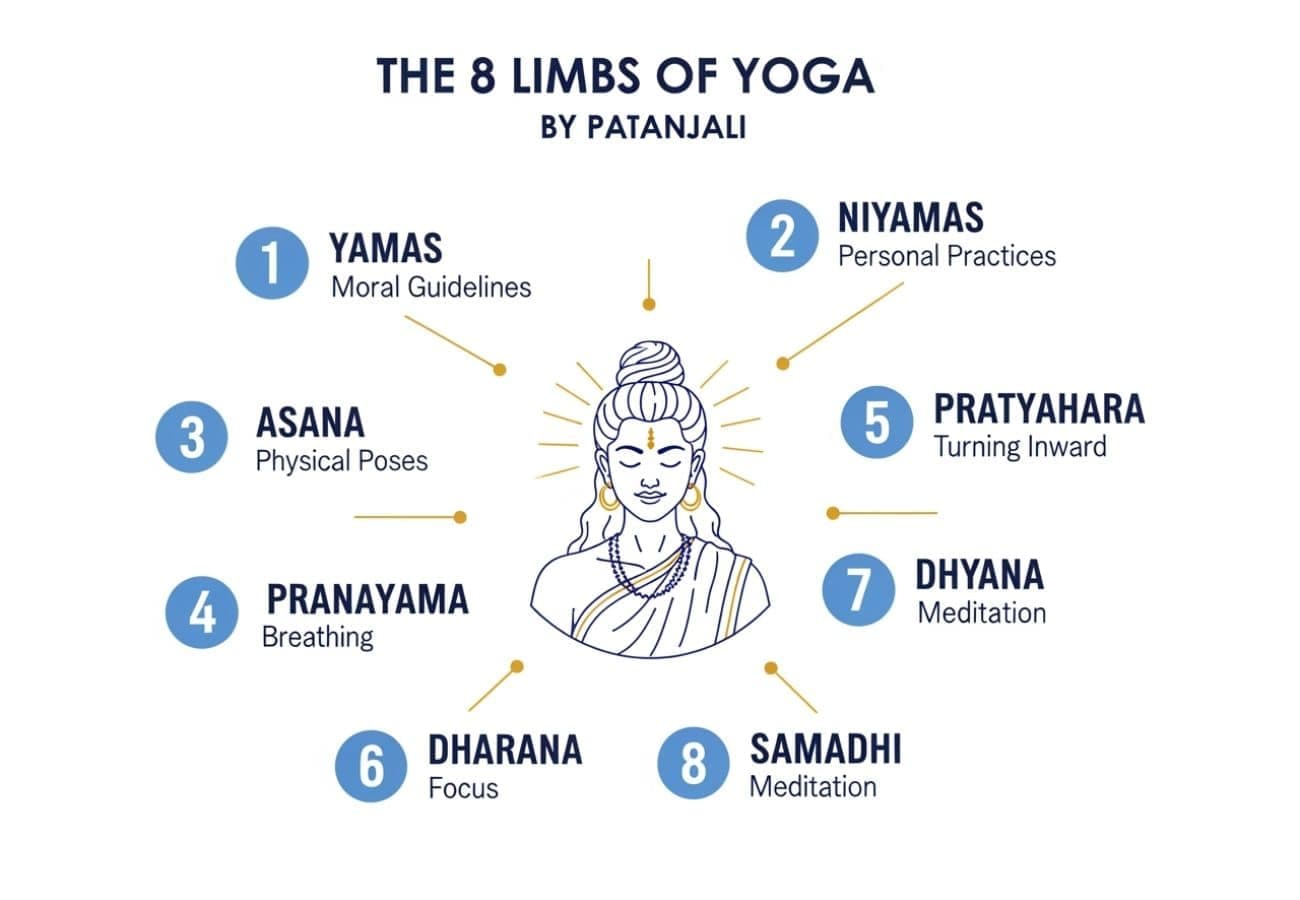

When most people begin their journey as yoga instructors, their primary focus is on the physical—how to instruct Chaturanga, how to sequence a peak pose, or how to offer hands-on assists. But as you spend more time in front of a class, you realize that teaching yoga is an energetic and spiritual transmission. To truly connect with students, we must look beyond physical alignment and anchor ourselves in yogic philosophy. Patanjali’s Yoga Sutras, written over 2,000 years ago, remain the ultimate handbook for modern teachers.
1. Atha Yoga Anushasanam: Cultivating Presence in the Shala
The very first sutra, Atha Yoga Anushasanam, is often translated as "Now, the exposition of yoga begins." The keyword here is Atha (Now). As a teacher, your first duty is to bring your students into the present moment. If you enter the shala distracted by your playlist, your emails, or personal worries, your students will feel that lack of presence. Ground yourself before every class, start with a moment of silence, and invite everyone to leave the outside world behind.
Applying this presence is key in advanced classes. If you're looking to deepen your own practice and teaching philosophy, consider checking out our 300-Hour Advanced Yoga Teacher Training.
2. Yogash Chitta Vritti Nirodha: Quieting the Student's Inner Critic
The second sutra defines the entire practice: "Yoga is the cessation of the fluctuations of the mind." In a modern yoga class, students are often fighting their inner critics. They compare themselves to the person next to them or stress about their flexibility. As a teacher, you are not a fitness coach; you are a guide helping them quiet these mental fluctuations. Structure your verbal cues to focus on breath and internal awareness rather than aesthetic perfection.
3. Sthira Sukham Asanam: Balancing effort and ease
Patanjali only mentions physical postures (asanas) in a few sutras. The most famous is Sthira Sukham Asanam: "Postures should be steady and comfortable." Many modern classes push students into athletic striving, causing them to hold their breath and tense their jaws. Teach your students to find the sweet spot between effort (Sthira) and ease (Sukha). Encourage them to use props, modify postures, and honor their bodies' limits on any given day.
For a deeper breakdown of how the Eight Limbs fit together, read our detailed 8 Limbs of Yoga Guide.
4. Abhyasa Vairagyabhyam: Practice and Detachment
Sutra 1.12 explains that the mind is stilled through constant practice (Abhyasa) and detachment (Vairagya). As a teacher, this applies directly to how you view your students' progress—and your own. You must practice teaching consistently, but detach yourself from the result. If a student falls out of a pose, or if a class doesn't go exactly as planned, practice detachment. Treat every class as a fluid, living experience.
Do you want to explore these teachings in depth? Feel free to contact our admissions office to learn about our philosophy-heavy immersions in Ubud.
Visit Our Ubud Sanctuary

Written by Vivek Kalura
Senior Faculty & Cultural Scholar. Guiding students to connect mechanical adjustments with spiritual lineage under the tropical Ubud foliage.
Become a Certified Teacher
Study anatomy, philosophy, and alignment in our immersive Ubud programs.