
Arm balances and handstands are often source points of fear and frustration for yoga practitioners. Going upside down requires shoulder stability, core strength, wrist flexibility, and above all, mental confidence. During our yoga teacher training, we dedicate a special afternoon workshop to deconstructing the mechanics of arm balances (like Crow, Side Crow, and Peacock) and handstands. This workshop breaks down these advanced poses into simple, safe progression steps.
1. Overcoming the Fear of Being Upside Down
The primary barrier to handstands is not physical strength—it is fear. Your brain is wired to protect your neck and head, so it resists when you try to kick up. To overcome this fear:
- Learn how to fall: We teach students how to roll or cartwheel out of a handstand safely, giving them the confidence to practice.
- Wall training: Using the wall to build endurance in L-stands, rather than kicking up blindly.
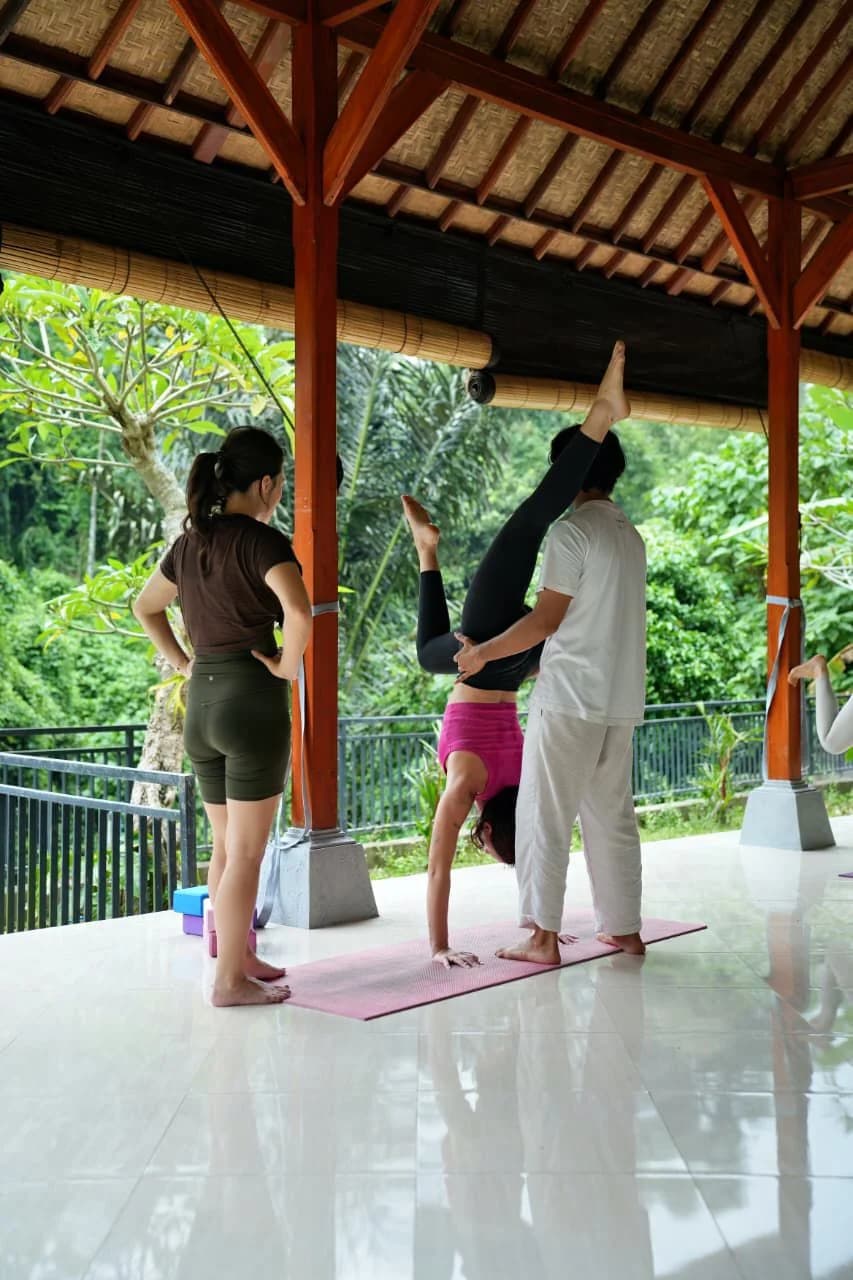
- Partner spotting: Working in teams of three, where spots ensure absolute safety.
2. The Biomechanics of Arm Balances
Arm balancing is not about muscular strength—it is about shifting your center of gravity.
| Key Alignment Point | Physical Action | Therapeutic Benefit |
|---|---|---|
| Hasta Bandha (Hand Lock) | Spread your fingers wide, clawing the mat with your fingertips. | Protects the wrist joint and allows micro-adjustments in balance. |
| Shoulder Protraction | Press the hands down, spreading the shoulder blades wide. | Creates a stable upper body shelf and prevents collapsing. |
| Core Activation (Uddiyana Bandha) | Pull the navel toward the spine and lift the pelvic floor. | Lightens the lower body, making lift-offs effortless. |
3. Hands-On Assists and Safety in Inversions
As future yoga teachers, learning how to safely spot and assist your students in inversions is a key skill. We teach trainees how to stand, where to hold, and how to offer stable physical assists without taking on the student's full weight. Read our guidelines on hands-on assists in our guide: Mastering Vinyasa Flow Alignment. This training is also an essential preparation for advanced certifications, like our 300-Hour Advanced Yoga Teacher Training.
4. Start Your Journey at Our Ubud Shala
Our handstand workshops take place in our open-air bamboo shala in Ubud. Review our shala facilities and rooms on our Sanctuary Accommodation page. If you are ready to study in Ubud under experienced lead teachers, view our upcoming training dates and secure your spot today.
Visit Our Ubud Sanctuary

Written by Vivek Kalura
Senior Faculty & Cultural Scholar. Guiding students to connect mechanical adjustments with spiritual lineage under the tropical Ubud foliage.
Become a Certified Teacher
Study anatomy, philosophy, and alignment in our immersive Ubud programs.