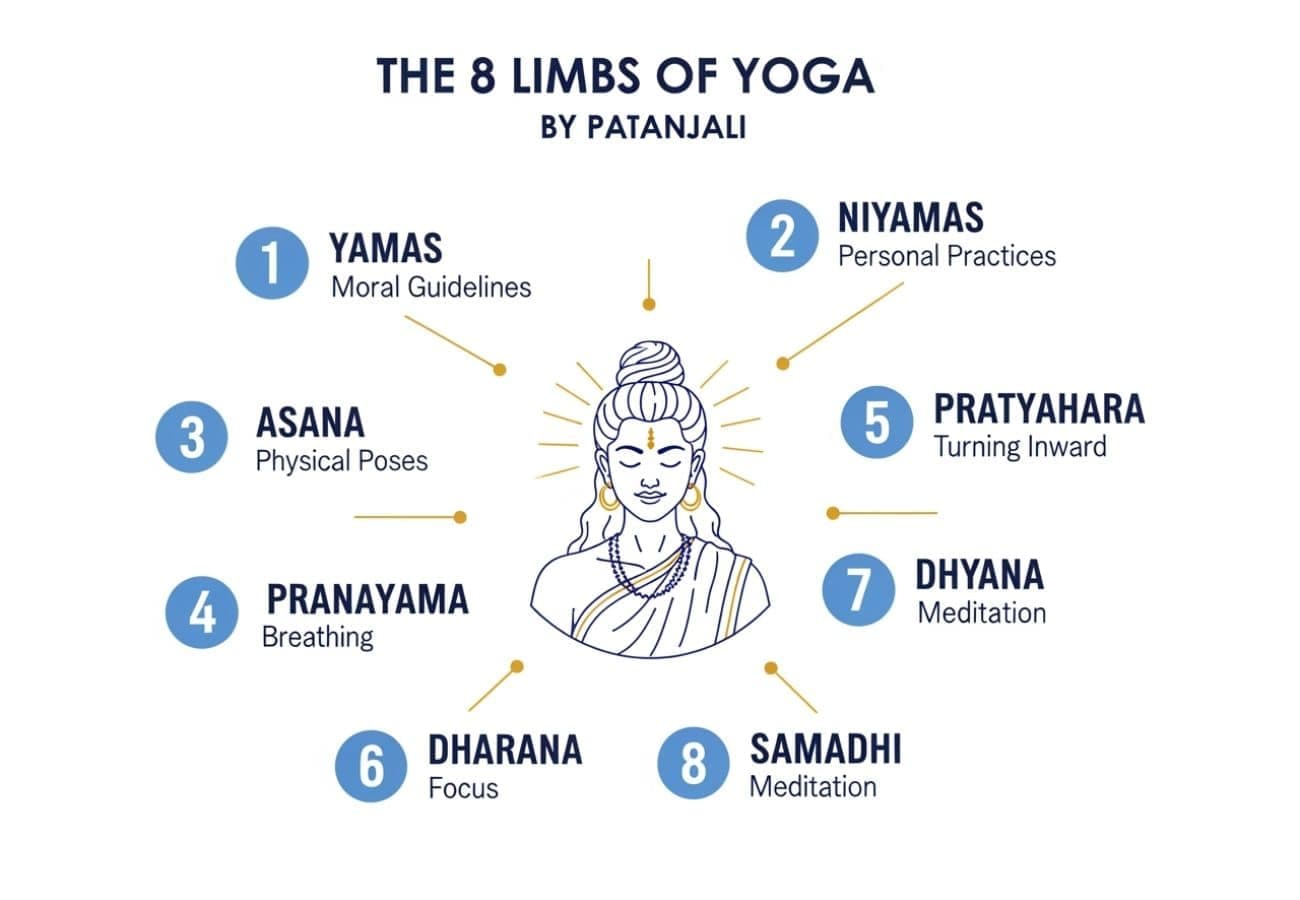

To the average modern observer, "yoga" refers to a series of physical stretches, balances, and inversions performed in a heated room. However, in the classical tradition, physical postures are just a fraction of the practice. In the Yoga Sutras, compiled by the sage Patanjali over 2,000 years ago, yoga is outlined as an eight-fold path called Ashtanga Yoga—the Eight Limbs of Yoga. As modern practitioners and teachers, understanding this complete path is crucial if we wish to teach yoga as a path of liberation rather than a simple fitness routine.
1. The Misconception of Yoga as Asana
Patanjali’s Yoga Sutras contain 196 aphorisms. Out of these, only three mention Asana (physical postures). The physical body is treated not as the final destination of yoga, but as a vehicle—a temple that must be purified, strengthened, and stabilized so that we can sit in silent meditation without pain or distraction. If we only practice asana, we are only practicing 12.5% of yoga. The other 87.5% is an internal, ethical, and meditative journey that quietens the fluctuations of the mind. Learn how we weave this philosophy into our teaching methodology in our 200-Hour Yoga Teacher Training in Bali.
2. The Outer Limbs: Yamas & Niyamas
The first two limbs of yoga form the ethical and personal foundation of the entire path. They are the rules of conduct that govern how we interact with the world and how we treat ourselves.
The Yamas (Social Ethics):
- Ahimsa (Non-violence): Practicing kindness and compassion toward all living beings, including ourselves. In a modern context, this means not pushing our bodies into painful alignments to satisfy our ego.
- Satya (Truthfulness): Living and speaking with honesty. This means being honest about our qualifications as teachers and acknowledging our limitations.
- Asteya (Non-stealing): Not taking what is not ours—including stealing others' time, energy, or claiming credit for their teachings.
- Brahmacharya (Energy Moderation): Directing our vital energy toward higher consciousness rather than wasting it on trivial distractions.
- Aparigraha (Non-possessiveness): Letting go of greed, attachment, and the desire to compare ourselves to others.
The Niyamas (Personal Observances):
- Saucha (Purity): Cleanliness of the body, mind, environment, and diet. Eating clean, high-vitality food supports this limb. Read about our approach to diet in our guide on Sattvic Food and Breathwork.
- Santosha (Contentment): Cultivating gratitude and peace with the present moment, exactly as it is.
- Tapas (Discipline): The burning heat of practice that purifies our bad habits and builds character.
- Svadhyaya (Self-study): Reading spiritual scriptures, journaling, and observing our own mental patterns.
- Ishvara Pranidhana (Surrender): Letting go of our ego and surrendering our actions to a higher intelligence.
3. The Bridge Limbs: Asana, Pranayama, and Pratyahara
Postures (Asana) align the physical structure. Breath control (Pranayama) expands our vital life-force energy (prana). We teach advanced pranayama techniques daily to help quiet the mind. Deepen your understanding of these techniques in our Complete Guide to Pranayama. The fifth limb, Pratyahara (withdrawal of the senses), acts as the bridge to the inner world. In our shala, we practice this during sound healing sessions. Read about how this sensory withdrawal occurs in our Power of Sound Baths article.
4. The Inner Limbs: Dharana, Dhyana, and Samadhi
Once the senses are turned inward, we enter the three final, internal stages of meditation:
- Dharana (Concentration): Binding the mind to a single point of focus, like a mantra, the breath, or a candle flame. Painting mandalas in our shala is a form of Dharana. Learn more on our YTT Activities page.
- Dhyana (Meditation): The state where concentration becomes effortless, and the mind flows in a continuous, uninterrupted stream toward the object of focus.
- Samadhi (Absorption): The final state of liberation where the observer, the process of observation, and the observed object dissolve into one, experiencing absolute bliss and peace.
Visit Our Ubud Sanctuary

Written by Vivek Kalura
Senior Faculty & Cultural Scholar. Guiding students to connect mechanical adjustments with spiritual lineage under the tropical Ubud foliage.
Become a Certified Teacher
Study anatomy, philosophy, and alignment in our immersive Ubud programs.